

by: Dr.Laura Sheerman 2nd june 2026
Proficiency in oral presentation skills is a vital requirement for future STEM professionals. It enables students to clearly convey complex, technical information to a wide range of industry stakeholders. Historically, technical capabilities took absolute priority within STEM pathways, while professional communication was frequently overlooked. However, employers now widely report that STEM graduates lack the soft skills needed to thrive in modern workplaces [1].
When we unpack why students underperform in public speaking, the literature points directly to the prevalence of public speaking fear, or glossophobia [2]. Traditional teaching approaches often fall short of preparing students for these pressures because they fail to provide adequate, realistic opportunities for rehearsal within a congested curriculum. Emergent educational technologies—specifically the combination of artificial intelligence (AI) and immersive virtual reality (IVR)—offer an innovative pedagogical framework to bridge this gap.
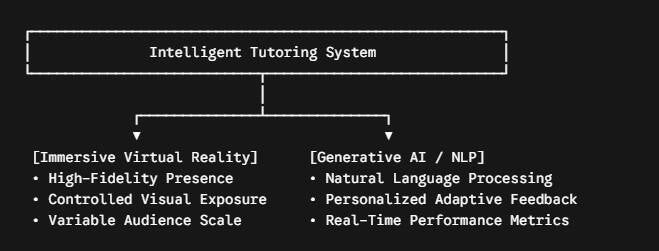
By functioning as an Intelligent Tutoring System (ITS), these combined technologies provide students with on-demand, high-fidelity, and psychologically safe spaces to scaffold their learning without the need for constant educator input or a live audience.
The Impact of Public Speaking Fear on Student Success
For many students, delivering a presentation in front of an audience triggers acute psychological states that evoke powerful physiological, behavioural, and cognitive responses:
- Physiological Arousal: Activation of the sympathetic nervous system triggers the classic "fight-or-flight" response, resulting in a racing heart, shortness of breath, and tightness in the chest.
- Behavioral and Cognitive Distortions: These internal states lead to observable behavioural changes, such as avoidance, speech disfluencies, and word blocking. Subjective, negative self-focused cognitions—like "Everyone is judging me"—further compound this stress, making students less adaptable and harming their academic and career progression.
Limitations of Current Educational Technologies
Current digital tools attempt to support student presentation development through rehearsal and feedback, but they present several limitations when used in isolation:
[Passive Videos] ──> Conceptual Knowledge Only (Lacks Physical Context)
[Active Recordings] ──> Heightens Self-Consciousness & Appearance Anxiety
[Digital Coaches] ──> Speech/Body Analytics (Lacks Authentic Audience Stress)
- Passive and Active Video: Passive videos showcase positive techniques to support reflection on presentation structure. Active video recordings involve students recording themselves for self-assessment or peer feedback. Self-conscious students with low confidence often focus on their physical appearance in the video rather than their presentation skills, which increases anxiety. Furthermore, video recordings add technical friction to the classroom, requiring extra educator time to manage the equipment.
- Digital Presentation Coaches: Systems like VoiceCoach or Automanner analyse speech cadence, volume modulation, and body movements [3]. While useful for technical adjustments, they do not expose students to authentic, audience-filled contexts. Because the audience is a major cause of public speaking fear, it must be central to any approach aiming to reduce that anxiety.
Designing Safe Learning Spaces with IVR and Generative AI
Immersive virtual reality leverages three-dimensional, computer-generated graphics to transfer the user from the physical classroom into a synthetic environment that is accepted as real. This experience relies on the interplay of immersion and presence—the psychological sensation of truly being physically present inside the virtual environment [4].
When integrated with Generative AI and Natural Language Processing (NLP), this system functions as an Intelligent Tutoring System capable of facilitating Personalised Adaptive Learning (PAL).
Instead of recording a video of themselves—which can be incredibly uncomfortable for anxious individuals—students can speak as an avatar within the IVR environment. This shifts their reflection onto their performance rather than their physical appearance (Zhou et al. 2021).
Generative AI introduces virtual adaptive audiences. These digital listeners respond dynamically to the presenter's voice patterns, gaze direction, and posture to mimic real-world audience reactions in real time.
Constructive Alignment and Pedagogical Scaffolding
From a pedagogical perspective, technology should never be used as a simple placeholder for effective teaching; we must always carefully consider its pedagogical application. IVR is inherently aligned with active, experiential, and contextual learning theories.
The Cognitive Affective Model of Immersive Learning (CAMIL) explains that factors like interest, intrinsic motivation, and self-regulation within IVR help students acquire and transfer factual, conceptual, and procedural knowledge.
Building these virtual environments into an Intelligent Tutoring System, can scaffold student learning in a way that aligns directly with Vygotsky’s Zone of Proximal Development (ZPD). This setup allows students to control their exposure to presentation stressors by manually adjusting specific variables before they begin:
- Audience Size: Scale up slowly from an empty room to a small peer group, and eventually to a full lecture hall.
- Audience Mood: Transition the audience from highly attentive and supportive to neutral or distracted.
- Session Duration: Control the length of the presentation to build stamina and confidence incrementally.
This flexibility allows students to manage their own learning pace without feeling overwhelmed. It helps replace old, negative associations of public speaking with positive experiences, supporting a lasting cognitive modification and improved performance.
Conclusion: Future Positioning in Education
Intelligent Tutoring Systems that integrate IVR and Generative AI give higher education programmes a unique opportunity to build a clear constructive alignment between learning outcomes and learning activities [5]. By offering an on-demand, low-stakes environment for repeated practice, this technology helps students manage the situational anxieties of public speaking. Integrating these immersive tools into regular teaching practice can significantly improve students' oral communication performance, enhance their employability prospects, and create more inclusive paths to success across STEM disciplines.
Post your thoughts below. Do you have a topic you want to write about, or you feel needs to be in focus?
[1] Gleason, M. L., & Leandro, L. F. (2023). Guiding STEM graduate students to better speaking skills. Trends in Biochemical Sciences, 48(2), 100-102. 10.1016/j.tibs.2022.10.005.
[2] Soomro MA, Siming IA, Shah SHR, Rajper MA, Naz S, Channa MA (2019) An investigation of anxiety factors during English oral presentation skills of engineering undergraduates in Pakistan. Int J Engl Linguist 9(3):203–210. https://doi.org/10.5539/ijel.v9n3p203
[3] Tanveer M.I., Zhao R., Chen K., Tiet Z., Hoque M.E. (2016), Automanner: An automated interface for making public speakers aware of their mannerisms, in Proceedings of the 21st International Conference on Intelligent User Interfaces, ACM, New York, NY, USA, 2016, pp. 385–396. doi.org/10.1145/2856767.285678
[4] Witmer BG, Singer MJ (1998) Measuring presence in virtual environments: A presence questionnaire. Presence 7:225–240. doi.org/10.1162/105474698565686.
[5] Biggs, J., & Tang, C. (2011). Train-the-trainers: Implementing outcomes-based teaching and learning in Malaysian higher education. Malaysian Journal of Learning and Instruction, 8, 1-19. https://eric.ed.gov/?id=ej1137298
Create Your Own Website With Webador