

Dr L. Sheerman - 11 june 2026
We talk a lot about engagement in digital learning. We invest in platforms, interactive content, and slick interfaces. But engagement without meaning is just activity. What actually moves learners – what makes knowledge stick – is story.
Story design, or narrative-based instructional design, is not a new idea. Jerome Bruner argued decades ago that human beings make sense of the world through narrative – that story is not the decoration around learning; it is the structure through which learning happens. Yet in digital learning environments, story is still frequently treated as optional — a nice-to-have wrapper around content, rather than a foundational design decision. That is a missed opportunity.
What is instructional story design?
Instructional story design is a systematic approach to learning design in which narrative is used as the primary vehicle for achieving performance objectives. It is distinct from simply illustrating content with examples or anecdotes. In instructional story design, the story is the curriculum: learners encounter knowledge through the experience of a character navigating a real professional dilemma, make decisions that carry consequences, and reflect on what those choices reveal about their own practice.
Rance Greene, whose Instructional Story Design (2020) has become a practitioner touchstone in this field, distils the approach into two non-negotiable design elements: a relatable character and strong conflict. Without both, learners have no reason to invest. With both, they have a reason to care — and caring, it turns out, is where learning begins. Greene's own background is instructive here. He transformed compliance training in a healthcare organisation into an action-based story platform — precisely the kind of context where abstract policy language is routinely treated with the engagement it deserves, which is to say, very little. It is a lesson the wider digital learning field has been slow to absorb.
Learning Scenes: Structure with purpose
What makes instructional story design more than narrative decoration is the concept of the learning scene. Each scene is not simply a plot beat — it is a carefully constructed decision point, anchored to a specific learning objective and designed to surface the tacit professional knowledge learners already hold. The conflict in each scene does the pedagogical work: it forces a choice, and choices reveal assumptions.
To make this concrete, consider Margaret — a fictional character developed as an example of instructional story design for community healthcare safeguarding training. She is an older adult living at home. When a community healthcare worker arrives for a routine visit, something feels off. Derek – introduced as her son – hovers close, answers questions on her behalf, and grows visibly uncomfortable when the worker attempts to speak with Margaret alone. There is a bruise. There is a hesitation. There is a moment where Margaret's eyes say something her words do not.
Scene one places the learner inside that moment. The decision is not: "what is the correct safeguarding procedure?" It is: "what do you do right now, in this room, with Derek standing three feet away?" That specificity — the particularity of the professional situation — is what Greene means by relatable conflict. It is not a vignette. It is a dilemma with real weight.
Five scenes, five learning moments
As an example of instructional story design, Margaret's scenario unfolds across five scenes, each targeting a distinct competency. Scene one foregrounds professional curiosity — the duty to look beyond the surface explanation when indicators are present. Scene two, once alone with Margaret, focuses on recognising financial abuse and asking safety questions without causing shame. Scene three is the hardest: Margaret discloses but begs the worker not to share it. Here the learning centres on the limits of confidentiality and the skill of honest, compassionate communication under pressure. Scene four introduces the Mental Capacity Act — Margaret has capacity, and overriding her on the assumption of vulnerability is both unlawful and disrespectful. Scene five brings Derek back, now confrontational, demanding to know what was discussed.
Figure 1: Story scenes
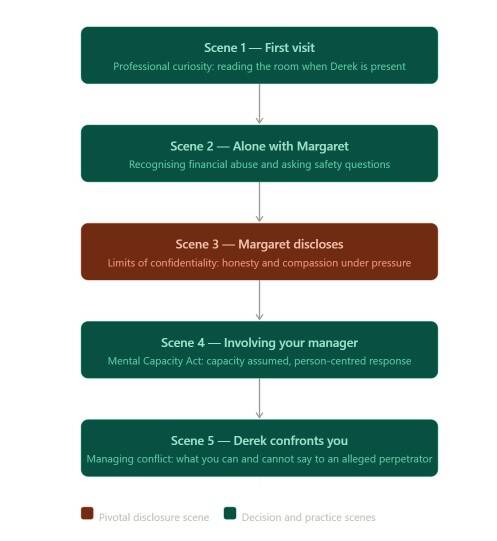
Each scene demands a decision. Each decision reveals something about where the learner is in their professional understanding. And crucially – for our purposes here – each scene generates something to talk about as a group.
Where Slack extends the story
Slack is a cloud-based messaging and collaboration platform widely used in workplace and educational settings. Organised around channels — persistent, topic-based spaces — and threaded conversations that keep discussion anchored to a specific prompt or question, it allows groups to communicate asynchronously across devices. Unlike email, Slack is designed for ongoing, visible dialogue: responses accumulate in threads, contributions can be built upon by others, and the conversation remains accessible to the whole group over time. In a learning context, these features make it particularly well-suited to structured peer discussion — and to extending a learning scenario beyond the moment of its delivery.
This is where Slack becomes pedagogically interesting. Vygotsky's social learning theory positions knowledge as something constructed through dialogue with others – shaped by language, context, and shared meaning-making. Kolb's experiential learning cycle adds the complementary insight that concrete experience becomes genuine understanding only through structured reflection. Margaret's scenario provides the concrete experience. Slack threads provide the reflective space.
Tied directly to a scene, a Slack thread does something a multiple-choice question cannot. After scene three — in which Margaret begs the worker to keep her secret — a thread prompt might read, 'She asked you not to tell anyone. How did you handle that, and what made it difficult?" What surfaces in that thread is not policy knowledge. It is the emotional reality of the work: the instinct to protect trust, the discomfort of overriding a patient's expressed wish, the fear of getting it wrong. That is exactly the tacit professional knowledge that safeguarding training needs to reach — and which classroom delivery alone rarely does.
Each of Margaret's five scenes can anchor its own thread, building a cumulative community of enquiry across the micro-credential. Learners who navigated scene four differently can account for their reasoning. Those who recognised Derek's "she gets confused" as a coercive control tactic can name what they spotted and why. The story creates the shared reference point; the thread creates the dialogue.
A note of caution
Instructional story design, like any approach, can be implemented poorly. A character who feels contrived, a conflict too easily resolved, or a Slack thread without facilitation will not generate the depth of reflection this kind of training requires. Psychological safety matters here in the literal sense — Margaret's scenario involves abuse, coercion, and difficult disclosure conversations, and learners may bring their own experiences to the material. The pedagogy must lead, always.
But when instructional story design is grounded in the real professional worlds of learners – and extended through structured peer dialogue – it offers something most compliance-facing digital learning still struggles to provide: a reason to care.
For community healthcare workers navigating the ambiguous, high-stakes territory of adult safeguarding, that may be exactly what the training needs to do.
Add comment
Comments